Quiet Space

A two-part look at the making of a No. 1 Top Rated Roblox showcase—and the later environment production and optimisation behind its successor.

Quiet Space project cover
Quiet Space — featured project image
/ A THANK YOU FOR READING

Take a moment with C418’s “Subwoofer Lullaby”—a little piece of music from the world that inspired Quiet Space.

/ OPTIONAL SOUNDTRACK

Listen to Joey Pecoraro’s “Fairy Tale”, a track closely associated with Quiet Space during its release.

A world shaped around the experience.

Quiet Space began as a rough map concept I had revisited from 2019. In April 2020, during my final year of high school, COVID-19 disrupted my day-to-day life. Self-isolation intensified the anxiety and stress I was already experiencing, and I found myself returning to the project as a creative refuge. I spent three days immersed in developing it, focusing on creating a quiet world that players could get lost in. The experience grew into a public release that reached several million players within days.

This case study brings together the original 2020 experience and later asset-production work for Quiet Space 2. While I no longer have the original project files, I can share the surviving story and outcome of the first experience alongside the modelling, UV, material and geometry optimisation undertaken for its successor. The two stages are kept distinct throughout.

A world shaped around the player journey.

From the initial concept to spatial blockout, the environment was designed to communicate through its composition rather than constant instruction.

01 / PROJECT CONTEXT

A personal project, built as a creative refuge.

Quiet Space began as a rough map concept I had revisited from 2019. In April 2020, during my final year of high school, COVID-19 disrupted my day-to-day life. Self-isolation intensified the anxiety and stress I was already experiencing, and I returned to the project as a creative outlet. I spent three days focused on building a quiet world that players could get lost in. That personal starting point informed the experience's atmosphere, pacing and exploration-led design.

02 / SPATIAL DESIGN & BLOCKOUT

Guide movement through composition, not instructions.

I approached the level layout as a continuous player journey. A forest shaped around a waterfall and lake provided the environmental direction, while a spiral served as a loose spatial reference—not a rigid formula. I used paths, elevation changes, sightlines and the relationship between open and enclosed spaces to establish a readable blockout. Bends in the terrain controlled what players could see at once, gradually revealing destinations while preserving room for optional exploration.

Translate the environment into usable in-game assets.

The later production work for Quiet Space 2 focused on low-poly modelling, practical asset construction and implementation in Roblox Studio.

03 / 3D MODELLING & ASSET PRODUCTION

Low-poly assets designed for real-time environments.

For Quiet Space 2, I created low-poly environment assets and supporting natural elements in Blender. I considered silhouette, proportion, scale, topology and material treatment so each model would read clearly in-game and sit coherently within the wider environment. UV unwrapping and texture mapping were planned around the intended viewing distance and the need to retain visual detail without carrying unnecessary texture cost. This asset work belongs to the sequel's later production, not the original 2020 release.

04 / ROBLOX STUDIO IMPLEMENTATION

Prepare assets for practical in-game use.

I brought the Quiet Space 2 assets into Roblox Studio, checking their scale, placement and relationship to surrounding environment pieces. The focus was on making models function as reusable parts of a playable world rather than isolated renders. Consistent proportions, material choices and visual language helped the assets feel like part of the same environment, while keeping their geometry and texture setup suitable for real-time rendering.
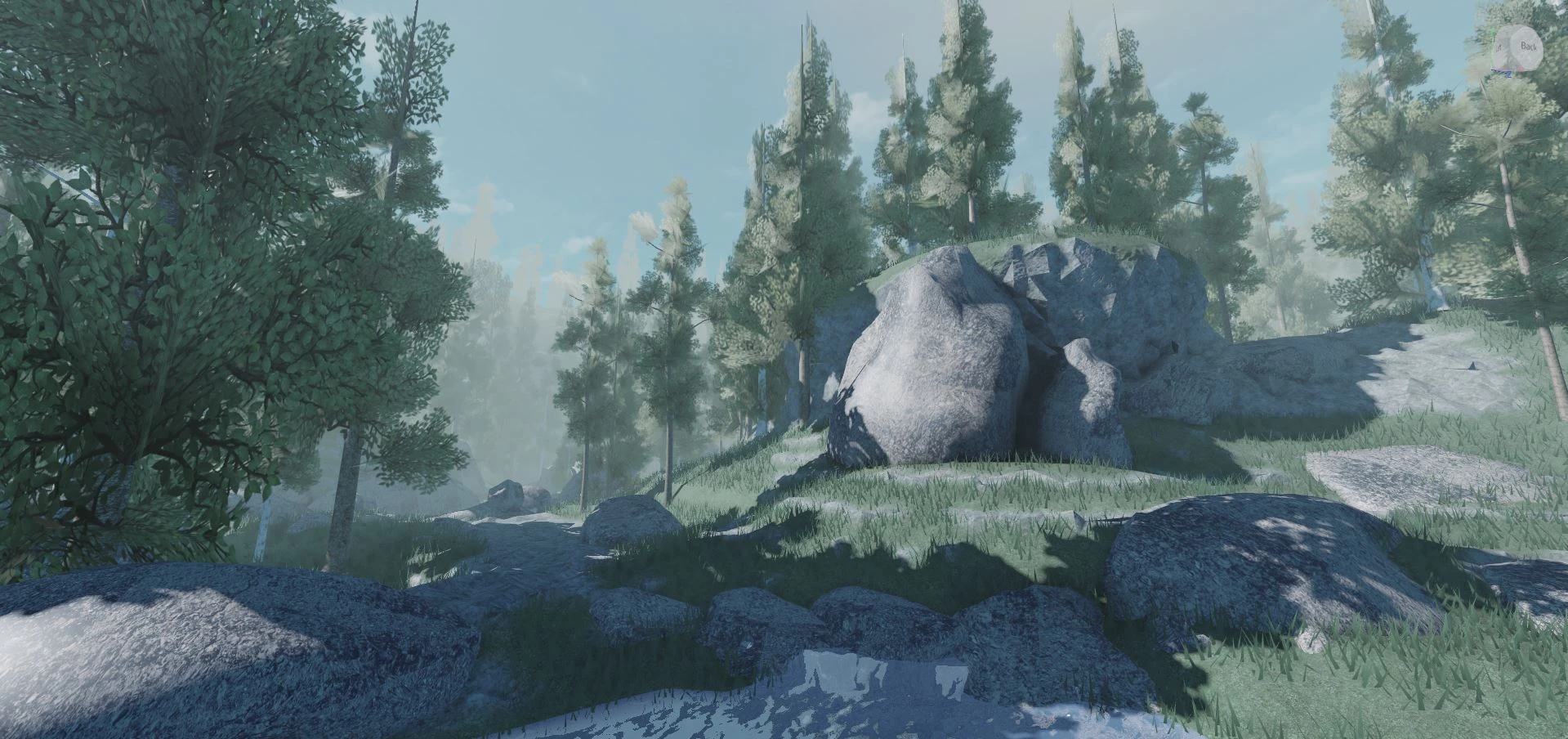
Balance visual clarity with technical efficiency.

Lighting, material setup and geometry reduction were considered together, preserving the visual character of the environment while reducing avoidable rendering overhead.

05 / LIGHTING & ENVIRONMENTAL POLISH

Use light, contrast and silhouettes to support readability.

Lighting and atmosphere helped establish mood while keeping important environmental forms legible. I considered how locations read at a distance, how silhouettes separated from their surroundings, and how contrast could distinguish one space from another. The waterfall and lake acted as prominent visual landmarks, while changes in elevation, bends in the paths and tighter passages revealed the environment progressively. The intention was to maintain visual cohesion without compromising orientation or player flow.

06 / GEOMETRY, MATERIALS & OPTIMISATION

Reduce triangle count and material overhead.

For the Quiet Space 2 tree assets, I reduced each model from more than 2,600 triangles to approximately 100–300 triangles—an estimated 88–96% reduction per tree. I consolidated separate wood materials into a shared texture atlas so multiple parts could use one material, reducing material changes and avoidable draw-call overhead. I also lowered individual texture resolutions and used efficient UV unwrapping and mapping to retain the intended pixel detail. For foliage, each leaf's image was mapped to a single triangle rather than a conventional two-triangle quad. This reduced repeated geometry across dense foliage, while requiring careful UV placement to avoid overlap and visible texture repetition.

Make exploration feel intuitive, then share it with players.

The original experience was developed and publicly released in a concentrated three-day period. Its reception became a defining milestone in my work.

07 / PLAYER FLOW & READABILITY

Let landmarks and layout guide discovery.

I considered the experience as a connected player journey rather than a collection of isolated locations. The waterfall, lake and distinctive silhouettes provided points of orientation, while optional routes encouraged players to explore beyond the main path. The pacing moved between open vistas and more enclosed discoveries, giving players opportunities to reorient themselves before entering smaller spaces. These were design intentions rather than the results of a formal playtest study; the priority was to make the world legible, navigable and rewarding to explore at each player's own pace.

08 / PUBLIC RELEASE & RECEPTION

A three-day project reached millions.

After three days of focused development, I released the original Quiet Space publicly. Within a couple of days, it had reached several million players and ranked as the No. 1 Top Rated experience in 2020. Its reception transformed a personal creative project into one of the most meaningful milestones in my work.

/ OUTCOME

A small personal project became a defining milestone.

Quiet Space reached several million players within days of release and became the No. 1 Top Rated experience in 2020.

Back to projects ↗